
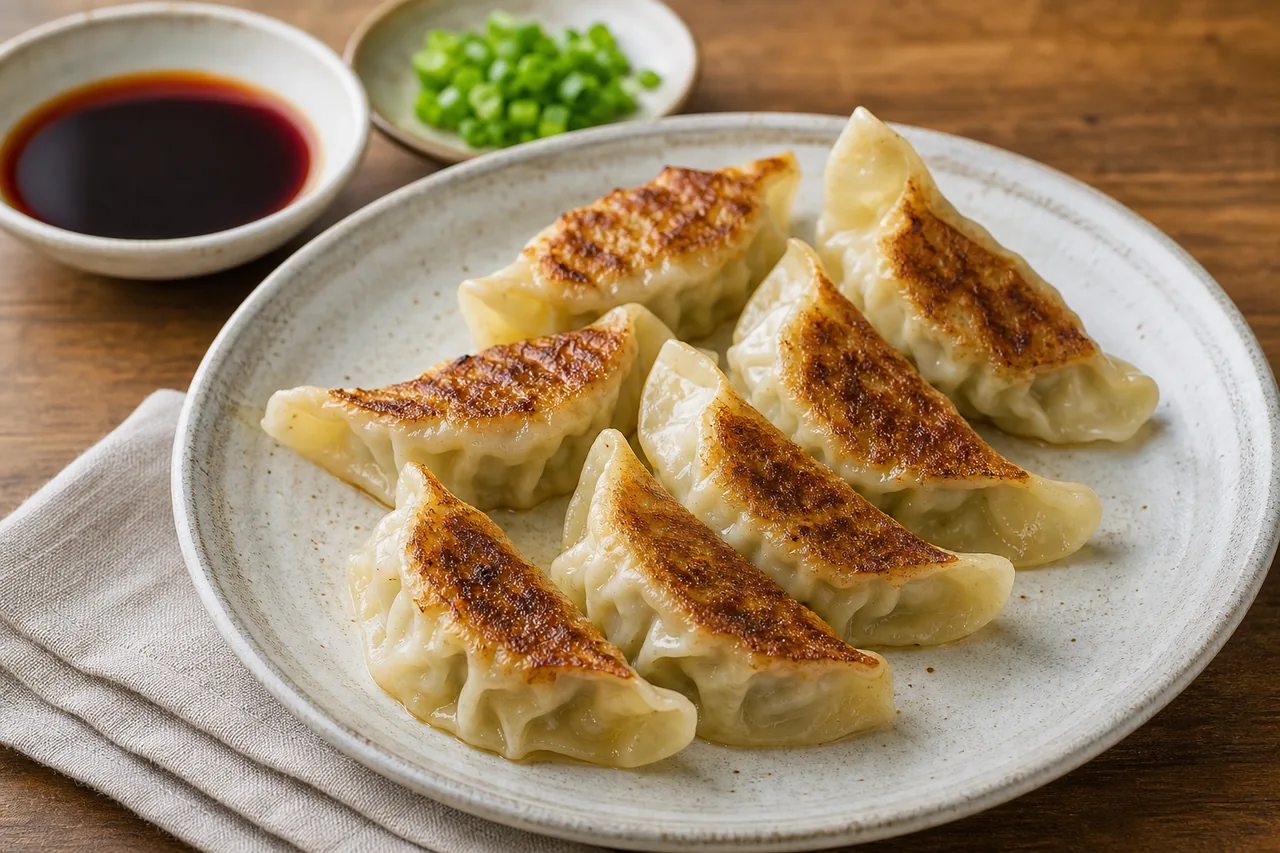
Gyoza are the most popular dumplings in Japan. The cooking technique is its main characteristic: they are steamed and at the same time fried on the base, creating a golden and crispy base with a soft and juicy top. Soy sauce with vinegar and sesame oil is the obligatory accompaniment.
Japanese
Steamed and grilled pork and cabbage gyoza
Japanese gyoza with minced pork and Chinese cabbage, steamed and grilled. The most popular dumpling in Japan, crispy on the bottom and tender on top.
- Japan
- MAIN COURSES
- Light
- Low sugar
- medium
40 min
Tiempo de Preparación
4
Servings
Nutrición por ración
- Calories 320 kcal
- Protein 18 g
- Fiber 2 g
- Carbohydrates 32 g
- Fat 12 g
- Sodium 880 mg
Story behind the dish
Preparation
Steamed and grilled pork and cabbage gyoza is a preparation from Japan with medium difficulty. Reserve about 55 minutes in total (40 for mise en place and preparation, 15 for cooking). Follow the 8 phases in order: each step indicates what to do, what to observe and, when applicable, the time or level of fire.
Before you start
- Have ready: 20 gyoza (or wonton) wafers.
- Have ready: 300 g of minced pork.
- Have ready: 150 g finely chopped Chinese cabbage.
- Have ready: 2 chopped chives.
- Have ready: 2 cloves of grated garlic.
- Salt, oil and spices measured and within reach.
- Clean utensils, board and clear work surface.
-
Salt the chopped cabbage; Let it rest for 10 minutes and squeeze it well.
Salt the chopped cabbage; Let it rest for 10 minutes and squeeze it well. Resting time is not optional: it improves texture, hydrates fibers and balances flavors.
Resting time is not optional: it improves texture, hydrates fibers and balances flavors.
-
Mix cabbage with meat
Mix the cabbage with the meat, garlic, ginger, chives, soy and sesame. Go slowly and confirm texture, aroma and color before moving to the next step.
Go slowly and confirm texture, aroma and color before moving to the next step.
-
Place 1 teaspoon filling on each wafer; seal by pressing and…
Place 1 teaspoon filling on each wafer; seal by pressing and making folds. Go slowly and confirm texture, aroma and color before moving to the next step.
Go slowly and confirm texture, aroma and color before moving to the next step.
-
In non-stick pan
In a nonstick skillet, heat oil; place the gyoza upright. Go slowly and confirm texture, aroma and color before moving to the next step.
Go slowly and confirm texture, aroma and color before moving to the next step.
-
Fry for 2 minutes until the base is golden brown.
Fry for 2 minutes until the base is golden. Look for a uniform golden color; The seal concentrates flavor and prevents it from releasing too much liquid later. Watch the exact point indicated; An extra minute can alter the result.
Look for a uniform golden color; The seal concentrates flavor and prevents it from releasing too much liquid later.
-
Add 80 ml of water; Cover and steam for 5-6 min until evaporated.
Add 80 ml of water; Cover and steam for 5-6 min until evaporated. Keep the steam constant; If the water in the base evaporates, add more heat without wetting the food. Watch the exact point indicated; An extra minute can alter the result.
Keep the steam constant; If the water in the base evaporates, add more heat without wetting the food.
-
Prepare the sauce by mixing all its ingredients
Prepare the sauce by mixing all its ingredients. Go slowly and confirm texture, aroma and color before moving to the next step.
Go slowly and confirm texture, aroma and color before moving to the next step.
-
Serve the gyoza with the sauce
Serve the gyoza with the sauce. Serve on a preheated plate or platter if the dish must maintain temperature.
Serve on a preheated plate or platter if the dish must maintain temperature.
Chef's tips
- Resting time is not optional: it improves texture, hydrates fibers and balances flavors.
- Keep the steam constant; If the water in the base evaporates, add more heat without wetting the food.
Community
Kitchen conversations
Share how it turned out, ask questions, or reply to other cooks.
Be the first to share your experience with this recipe.