
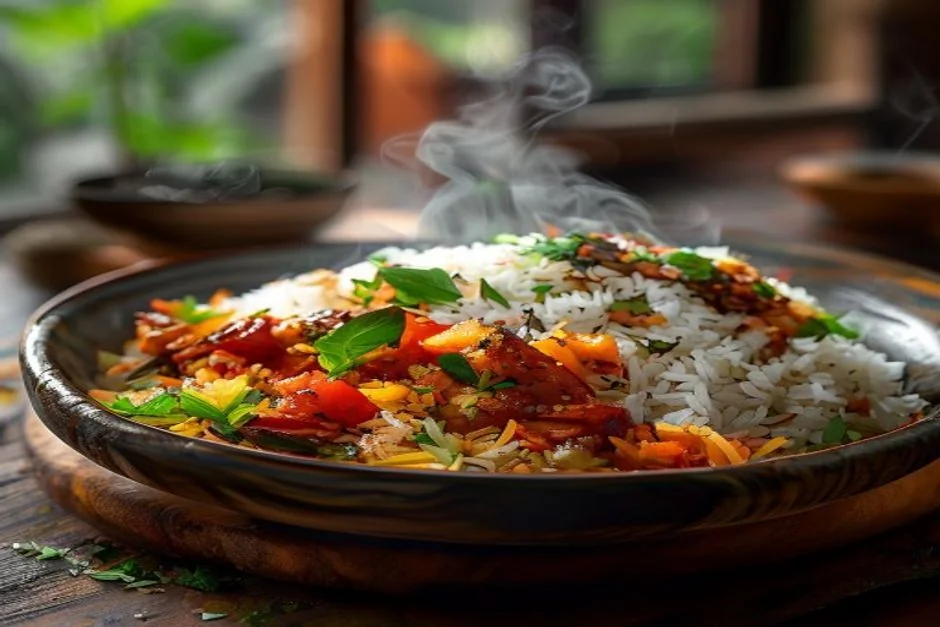
An Indonesian fried rice dish with Chinese influence, nasi goreng is everyday and street food throughout Indonesia, considered one of the most representative dishes of the country.
Asian
Nasi Goreng
Traditional Indonesian nasi goreng - fried rice with kecap manis, authentic step by step recipe.
- Indonesia
- Main course
- High protein
- easy
15 min
Tiempo de Preparación
4
Servings
Nutrición por ración
- Calories 460 kcal
- Protein 20 g
- Carbohydrates 58 g
- Fat 16 g
Story behind the dish
Preparation
Nasi Goreng is an Indonesian preparation with easy difficulty. Set aside about 30 minutes in total (15 for mise en place and preparation, 15 for cooking). Follow the 6 phases in order: each step indicates what to do, what to observe and, when applicable, the time or level of fire.
Before you start
- Have ready: 600 g of cooked rice (preferably from the day before).
- Have ready: 200 g of chicken or shrimp.
- Have ready: 2 eggs.
- Have ready: 3 shallots.
- Have ready: 3 cloves of garlic.
- Salt, oil and spices measured and within reach.
- Clean utensils, board and clear work surface.
-
Crush shallot
Grind shallot, garlic and chili until you get a fine paste. Go slowly and confirm texture, aroma and color before moving to the next step. Watch the exact point indicated; An extra minute can alter the result. Go slowly and confirm texture, aroma and color before moving to the next step. Watch the exact point indicated; An extra minute can alter the result.
Go slowly and confirm texture, aroma and color before moving to the next step.
-
Sauté the pasta in very hot oil until it releases aroma.
Sauté the pasta in very hot oil until it releases aroma. Stir frequently so it doesn't stick. The objective is to concentrate aromas, not to accelerate with excessive heat. Stir frequently so it doesn't stick. The objective is to concentrate aromas, not to accelerate with excessive heat.
Stir frequently so it doesn't stick. The objective is to concentrate aromas, not to accelerate with excessive heat.
-
Add chicken or prawns and sauté until cooked
Add the chicken or prawns and sauté until cooked. Work in batches if skillet is full; too much load generates steam and cooks instead of sautéing. Work in batches if skillet is full; too much load generates steam and cooks instead of sautéing.
Work in batches if skillet is full; too much load generates steam and cooks instead of sautéing.
-
Add the cold rice
Add the cold rice, breaking it up with the spatula so that there are no lumps, and sauté over high heat. Work in batches if skillet is full; too much load generates steam and cooks instead of sautéing. Work in batches if skillet is full; too much load generates steam and cooks instead of sautéing.
Work in batches if skillet is full; too much load generates steam and cooks instead of sautéing.
-
Add the kecap manis and shrimp sauce
Add the kecap manis and shrimp sauce, sauté everything together until the rice becomes uniform in color. Work in batches if skillet is full; too much load generates steam and cooks instead of sautéing. Work in batches if skillet is full; too much load generates steam and cooks instead of sautéing.
Work in batches if skillet is full; too much load generates steam and cooks instead of sautéing.
-
Serve with a fried egg on top
Serve with a fried egg on top, cucumber, tomato and crispy fried onion. Serve on a preheated plate or platter if the dish must maintain temperature. Serve on a preheated plate or platter if the dish must maintain temperature.
Serve on a preheated plate or platter if the dish must maintain temperature.
Chef's tips
- Always use cold rice from the day before, freshly made rice is soggy when sautéed.
- The wok must be very hot to achieve the characteristic quick stir-fry.
Variations
- Nasi goreng vegetariano con tofu.
- Nasi goreng with beef.
Community
Kitchen conversations
Share how it turned out, ask questions, or reply to other cooks.
Be the first to share your experience with this recipe.