
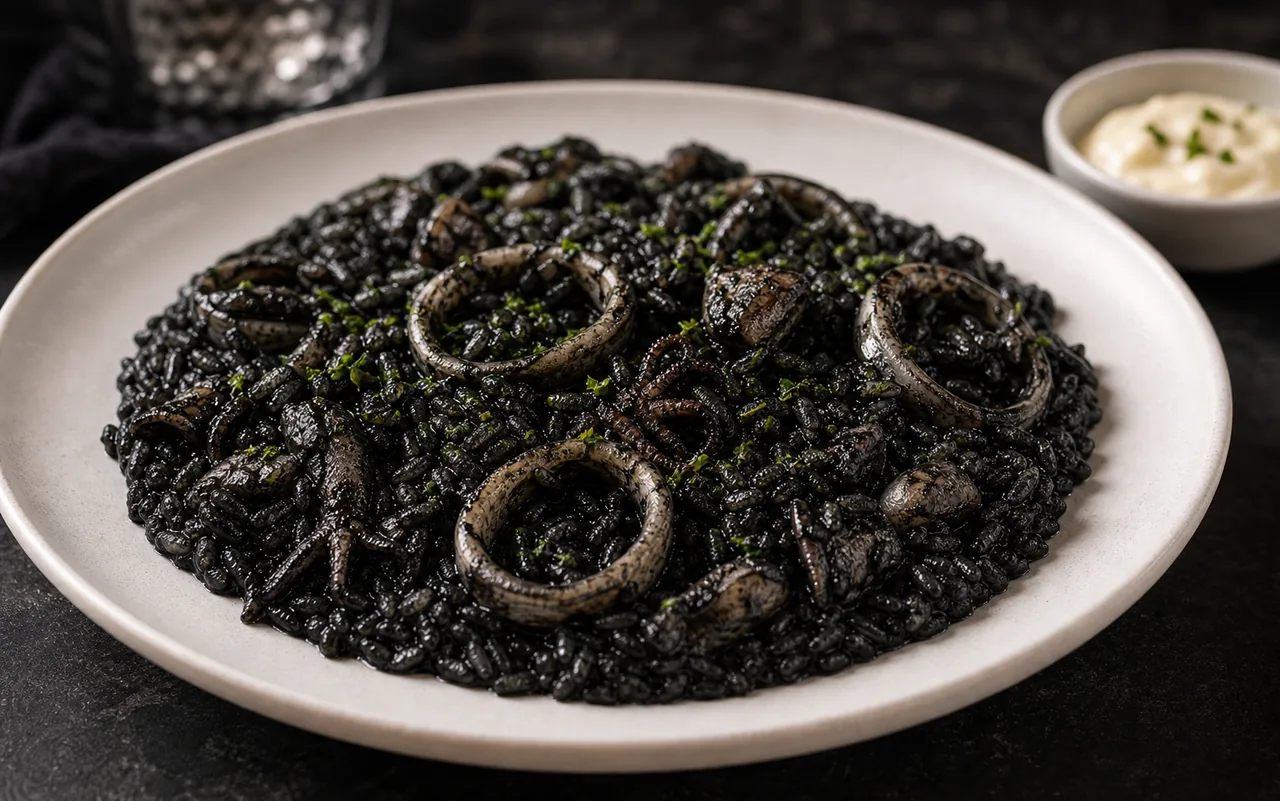
Squid in its ink is an iconic dish of Basque and Mediterranean cuisine. The squid ink not only dyes the sauce deep black but also provides an unmatched oceanic flavor. Served with black rice with aioli, it is one of the most spectacular seafood dishes in Spanish gastronomy.
Mediterranean
Squid in its ink with black rice
Calamari in its ink with black rice Mediterranean style. Seafood dish rich in iodine, proteins and marine plant compounds.
- Spain
- MAIN COURSES
- High protein
- Low fat
- Low sugar
- medium-high
25 min
Tiempo de Preparación
4
Servings
Nutrición por ración
- Calories 420 kcal
- Protein 32 g
- Fiber 2 g
- Carbohydrates 48 g
- Fat 9 g
- Sodium 680 mg
Story behind the dish
Preparation
Calamari in its ink with black rice is a preparation from Spain with high difficulty. Reserve about 70 minutes in total (25 for mise en place and preparation, 45 for cooking). Follow the 8 phases in order: each step indicates what to do, what to observe and, when applicable, the time or level of fire.
Before you start
- Have ready: 800 g of clean squid with ink bags.
- Have ready: 300 g short grain rice.
- Have ready: 3 envelopes of squid ink (reinforcement).
- Have ready: 2 large onions, chopped.
- Have ready: 3 grated ripe tomatoes.
- Salt, oil and spices measured and within reach.
- Clean utensils, board and clear work surface.
-
Clean the squid; store ink bags in water
Clean the squid; Store ink bags in water. Cut the bodies into rings. Go slowly and confirm texture, aroma and color before moving to the next step. In demanding recipes, do not improvise times: precision makes the difference.
Go slowly and confirm texture, aroma and color before moving to the next step.
-
Sauté the onion and garlic in oil for 15 minutes until golden.
Sauté the onion and garlic in oil for 15 minutes until golden. Look for a uniform golden color; The seal concentrates flavor and prevents it from releasing too much liquid later. In demanding recipes, do not improvise times: precision makes the difference.
Look for a uniform golden color; The seal concentrates flavor and prevents it from releasing too much liquid later.
-
Add the tomato and cook 10 min
Add the tomato and cook 10 min. Go slowly and confirm texture, aroma and color before moving to the next step. In demanding recipes, do not improvise times: precision makes the difference.
Go slowly and confirm texture, aroma and color before moving to the next step.
-
Add the squid and cook for 5 min.
Add the squid and cook for 5 min. Go slowly and confirm texture, aroma and color before moving to the next step. In demanding recipes, do not improvise times: precision makes the difference.
Go slowly and confirm texture, aroma and color before moving to the next step.
-
Dissolve the ink in the red wine; pour over stew
Dissolve the ink in the red wine; pour over stew. Go slowly and confirm texture, aroma and color before moving to the next step. In demanding recipes, do not improvise times: precision makes the difference.
Go slowly and confirm texture, aroma and color before moving to the next step.
-
Add the fumet and cook, covered, for 25 minutes over low heat.
Add the fumet and cook, covered, for 25 minutes over low heat. Go slowly and confirm texture, aroma and color before moving to the next step. In demanding recipes, do not improvise times: precision makes the difference.
Go slowly and confirm texture, aroma and color before moving to the next step.
-
In another pot
In another saucepan, sauté the rice for 2 minutes; pour the squid stew and cook 18 min. Stir frequently so it doesn't stick. The objective is to concentrate aromas, not to accelerate with excessive heat. In demanding recipes, do not improvise times: precision makes the difference.
Stir frequently so it doesn't stick. The objective is to concentrate aromas, not to accelerate with excessive heat.
-
Serve with aioli and chopped parsley.
Serve with aioli and chopped parsley. Serve on a preheated plate or platter if the dish must maintain temperature. In demanding recipes, do not improvise times: precision makes the difference.
Serve on a preheated plate or platter if the dish must maintain temperature.
Chef's tips
- Don't overcrowd the pan: the oil should be hot but not smoking.
- Serve immediately after resting: the temperature contrast enhances aroma and texture.
Community
Kitchen conversations
Share how it turned out, ask questions, or reply to other cooks.
Be the first to share your experience with this recipe.