
Although associated with France, the croissant descends from the Austrian kipferl, introduced in Paris in the 19th century and transformed with the French puff pastry technique to become an icon of the French bakery.
Mediterranean
Croissant
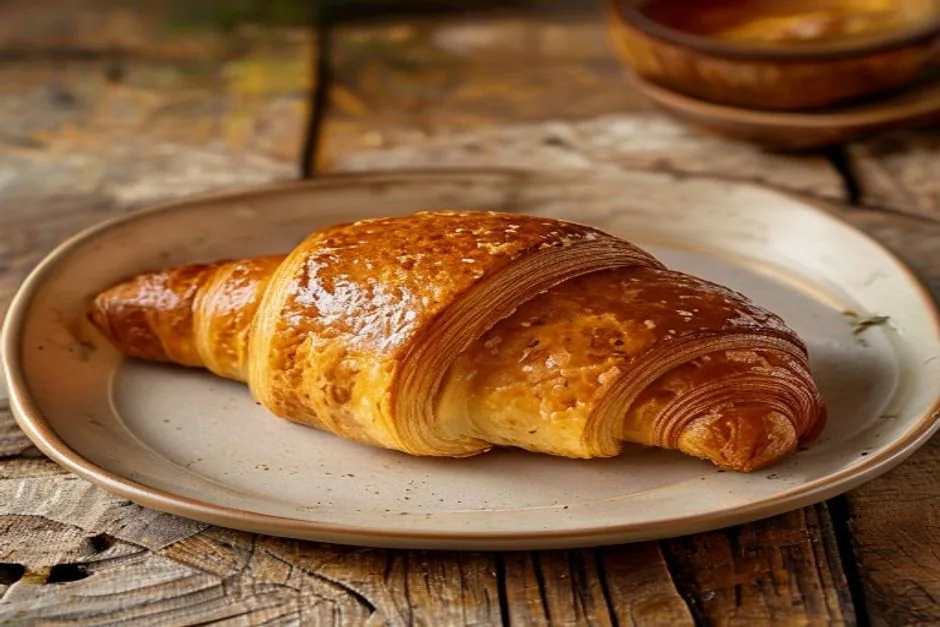
Homemade flaky French croissant, traditional step-by-step recipe with butter lamination.
- France
- Breakfast
- Light
- medium
60 min
Tiempo de Preparación
8
Servings
Nutrición por ración
- Calories 270 kcal
- Protein 5 g
- Carbohydrates 26 g
- Fat 16 g
Story behind the dish
Preparation
Croissant is a preparation from France with difficult difficulty. Reserve about 80 minutes in total (60 for mise en place and preparation, 20 for cooking). Follow the 6 phases in order: each step indicates what to do, what to observe and, when applicable, the time or level of fire.
Before you start
- Have ready: 500 g of strong flour.
- Have ready: 10 g of salt.
- Have ready: 55 g of sugar.
- Have ready: 10 g of fresh yeast.
- Have ready: 280 ml of cold water.
- Salt, oil and spices measured and within reach.
- Clean utensils, board and clear work surface.
-
Kneads flour
Knead flour, salt, sugar, yeast and water until you obtain a smooth dough. Let it rest in the cold for 1 hour. Resting time is not optional: it improves texture, hydrates fibers and balances flavors. In demanding recipes, do not improvise times: precision makes the difference. Resting time is not optional: it improves texture, hydrates fibers and balances flavors. In demanding recipes, do not improvise times: precision makes the difference.
Resting time is not optional: it improves texture, hydrates fibers and balances flavors.
-
Roll out the dough into a rectangle and place the butter in the center
Roll out the dough into a rectangle and place the butter in the center, wrap it like a package. The dough should be smooth and elastic; If it breaks when stretched, add liquid one at a time. In demanding recipes, do not improvise times: precision makes the difference. The dough should be smooth and elastic; If it breaks when stretched, add liquid one at a time. In demanding recipes, do not improvise times: precision makes the difference.
The dough should be smooth and elastic; If it breaks when stretched, add liquid one at a time.
-
Stretch and fold in 3 (single fold)
Stretch and fold in 3 (single fold), wrap and refrigerate for 30 minutes. Repeat this step 3 times. Go slowly and confirm texture, aroma and color before moving to the next step. In demanding recipes, do not improvise times: precision makes the difference. Go slowly and confirm texture, aroma and color before moving to the next step. In demanding recipes, do not improvise times: precision makes the difference.
Go slowly and confirm texture, aroma and color before moving to the next step.
-
Roll out the final dough to 4 mm thickness
Stretch the final dough to 4 mm thick, cut triangles and roll them from the base to the tip. The dough should be smooth and elastic; If it breaks when stretched, add liquid one at a time. In demanding recipes, do not improvise times: precision makes the difference. The dough should be smooth and elastic; If it breaks when stretched, add liquid one at a time.In demanding recipes, do not improvise times: precision makes the difference.
The dough should be smooth and elastic; If it breaks when stretched, add liquid one at a time.
-
Place on a tray forming the characteristic curve and let it ferment…
Place on a tray forming the characteristic curve and let it ferment for 2 hours until doubled in volume. Go slowly and confirm texture, aroma and color before moving to the next step. In demanding recipes, do not improvise times: precision makes the difference. Go slowly and confirm texture, aroma and color before moving to the next step. In demanding recipes, do not improvise times: precision makes the difference.
Go slowly and confirm texture, aroma and color before moving to the next step.
-
Paint with egg and bake at 200°C for 15-18 minutes until golden.
Paint with egg and bake at 200°C for 15-18 minutes until golden. Look for a uniform golden color; The seal concentrates flavor and prevents it from releasing too much liquid later. In demanding recipes, do not improvise times: precision makes the difference. Look for a uniform golden color; The seal concentrates flavor and prevents it from releasing too much liquid later. In demanding recipes, do not improvise times: precision makes the difference.
Look for a uniform golden color; The seal concentrates flavor and prevents it from releasing too much liquid later.
Chef's tips
- The butter and dough should be at similar temperatures for uniform rolling.
- The cold between folds is key for well-defined layers.
Variations
- Pain au chocolat (same chocolate-filled puff pastry)
- Almond croissant
Community
Kitchen conversations
Share how it turned out, ask questions, or reply to other cooks.
Be the first to share your experience with this recipe.