
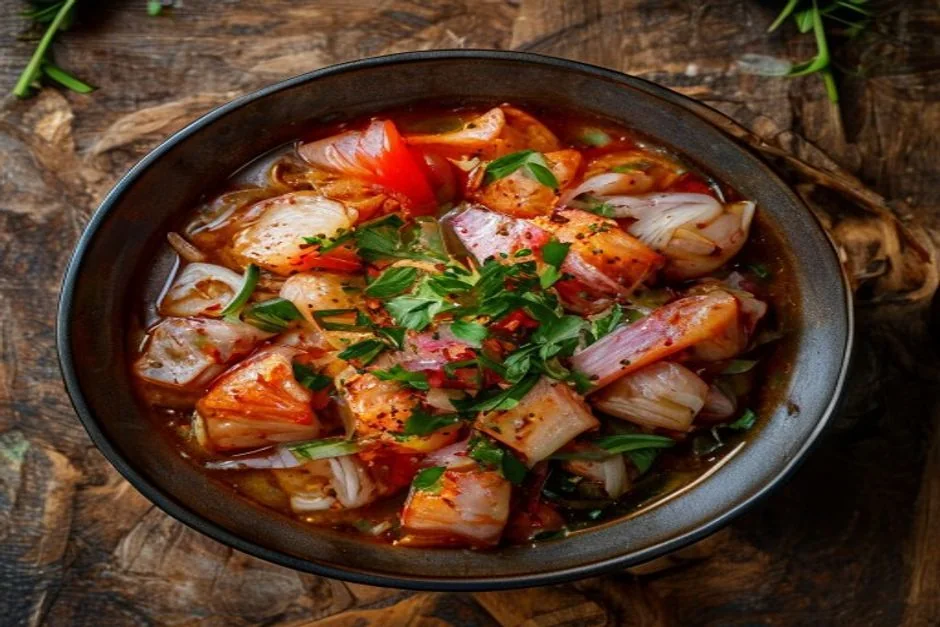
Traditional Korean stew (jjigae) made from fermented kimchi, a mainstay of Korean cuisine, especially popular as a home-cooked comfort dish.
Asian
Kimchi Jjigae
Traditional Korean kimchi jjigae: spicy kimchi stew with pancetta, step by step recipe.
- South Korea
- soup
- Light
- High protein
- easy
10 min
Tiempo de Preparación
4
Servings
Nutrición por ración
- Calories 380 kcal
- Protein 22 g
- Carbohydrates 14 g
- Fat 26 g
Story behind the dish
Preparation
Kimchi Jjigae is a South Korean preparation with easy difficulty. Reserve about 35 minutes in total (10 for mise en place and preparation, 25 for cooking). Follow the 6 phases in order: each step indicates what to do, what to observe and, when applicable, the time or level of fire.
Before you start
- Have ready: 400 g of well-fermented kimchi.
- Have ready: 200 g of pork belly in pieces.
- Have ready: 300 g of firm tofu.
- Have ready: 1/2 onion.
- Have ready: 2 chives.
- Salt, oil and spices measured and within reach.
- Clean utensils, board and clear work surface.
-
Sauté the bacon in a pot until it releases fat and turns golden brown.
Sauté the bacon in a pot until it releases fat and turns golden brown. Work in batches if skillet is full; too much load generates steam and cooks instead of sautéing. Work in batches if skillet is full; too much load generates steam and cooks instead of sautéing.
Work in batches if skillet is full; too much load generates steam and cooks instead of sautéing.
-
Add the chopped kimchi and sauté for 3-4 minutes along with the bacon.
Add the chopped kimchi and sauté for 3-4 minutes along with the bacon. Work in batches if skillet is full; too much load generates steam and cooks instead of sautéing. Work in batches if skillet is full; too much load generates steam and cooks instead of sautéing.
Work in batches if skillet is full; too much load generates steam and cooks instead of sautéing.
-
Add gochujang
Add the gochujang, gochugaru and garlic, sauté for 1 more minute. Stir frequently so it doesn't stick. The objective is to concentrate aromas, not to accelerate with excessive heat. Stir frequently so it doesn't stick. The objective is to concentrate aromas, not to accelerate with excessive heat.
Stir frequently so it doesn't stick. The objective is to concentrate aromas, not to accelerate with excessive heat.
-
Pour in the broth or water to cover and bring to a boil.
Pour in the broth or water to cover and bring to a boil. Go slowly and confirm texture, aroma and color before moving to the next step. Watch the exact point indicated; An extra minute can alter the result. Go slowly and confirm texture, aroma and color before moving to the next step. Watch the exact point indicated; An extra minute can alter the result.
Go slowly and confirm texture, aroma and color before moving to the next step.
-
Cook over medium heat for 15 minutes so that the flavors integrate.
Cook over medium heat for 15 minutes so that the flavors integrate. Go slowly and confirm texture, aroma and color before moving to the next step. Go slowly and confirm texture, aroma and color before moving to the next step.
Go slowly and confirm texture, aroma and color before moving to the next step.
-
Add the diced tofu and the spring onion for the last 5 minutes.
Add the diced tofu and the spring onion for the last 5 minutes, serve very hot with rice. Serve on a preheated plate or platter if the dish must maintain temperature. Serve on a preheated plate or platter if the dish must maintain temperature.
Serve on a preheated plate or platter if the dish must maintain temperature.
Chef's tips
- Use well-fermented kimchi (more sour, not fresh) for a deeper, more authentic flavor.
- The fat from the bacon adds body to the broth, do not discard it.
Variations
- Kimchi jjigae with tuna instead of pork
- Vegetarian version with more tofu and no bacon
Community
Kitchen conversations
Share how it turned out, ask questions, or reply to other cooks.
Be the first to share your experience with this recipe.